 HertzKit MUSIC TOOLS
PRACTICAL GUIDE
How to train your musical ear
Practice intervals and chords with clear references. Choose 4 intervals, 12 intervals or your own selection, listen before answering and review missed exercises at your pace.
On this page6 sections
Relative pitch lets you compare pitches and recognize relationships between notes. Practice by listening, answering and checking what happened. Identifying an isolated note without a reference is not required. This guide offers a route through the trainer, not a learning deadline or an assessment of musical ability.
What an interval is
An interval relates two pitches. Semitones describe its chromatic distance; its written name also depends on the note spelling. Adjacent piano keys are one semitone apart. These examples ascend from C4 using the trainer’s twelve-note equal temperament:
| Interval | Semitones | Ascending example |
|---|---|---|
| Minor 2nd | 1 | C4 → D♭4 |
| Major 2nd | 2 | C4 → D4 |
| Minor 3rd | 3 | C4 → E♭4 |
| Major 3rd | 4 | C4 → E4 |
| Perfect 4th | 5 | C4 → F4 |
| Tritone | 6 | C4 → F♯4 |
| Perfect 5th | 7 | C4 → G4 |
| Minor 6th | 8 | C4 → A♭4 |
| Major 6th | 9 | C4 → A4 |
| Minor 7th | 10 | C4 → B♭4 |
| Major 7th | 11 | C4 → B4 |
| Octave | 12 | C4 → C5 |
You can associate an interval with a familiar phrase, but check its version, starting point and direction. Recognizing a known melody does not yet mean recognizing that distance in every context. The trainer changes the starting note.
Minor third · 3 semitones
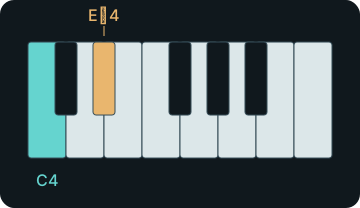
Major third · 4 semitones
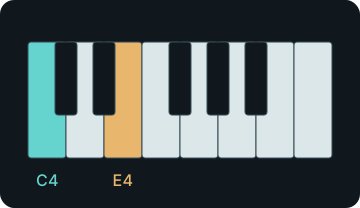
Both examples start on C4. Include black keys when counting semitones. The trainer changes the starting note, so listen to the distance rather than memorising these two keys.
How to start without getting frustrated
4 intervals includes minor 3rd, major 3rd, perfect 5th and octave. If there are too many options, select Choose and keep just two. A minor 3rd spans three semitones; a major 3rd spans four. Compare them from the same note before adding other distances. 12 intervals offers twelve intervals up to the octave.
Listen without answering and try singing the second note. Replay if needed; replaying does not add answers. After a miss, alternate Hear my choice and Hear the answer. Both keep the exercise’s reference and position. Descending intervals also keep the same starting note.
Start with one direction and a few options. Changing exercise, level, choices, direction or position starts a fresh session, so different tasks are not mixed in the score. Changing volume or reinforcement does not reset it.
Using the ear trainer
- Choose Intervals, Triads or Seventh chords. Each mode shows its own settings.
- Press Play and wait for it to finish before answering. Stop interrupts playback; one complete playback is needed to enable the first answer.
- Answer once and compare if needed. Next exercise prepares another without autoplay. Leaving the window stops the sound.
For triads, start with major and minor or use all four types. Major: 0–4–7 semitones above the root; minor: 0–3–7; diminished: 0–3–6; augmented: 0–4–8. Listen for the third, then the change in the fifth. Emotional labels do not replace those relationships.
Open Session results to review each type. An option that has not appeared yet shows a dash rather than zero percent. Reinforcement increases the probability of missed exercises, up to a limit; it does not guarantee the next exercise or measure all listening skills.
Download TXT before closing or reloading. Scores are not saved automatically or synced to My account. New session clears answers after confirmation. The optional draft keeps settings, including custom intervals, without score or audio.
Beyond the trainer
Work out a simple melody by ear on your instrument: the guide to transcribing by ear explains the method, and the audio speed changer slows things down without changing the pitch. Listen to a major and a minor scale back to back in chord & scale finder: comparing what you hear with what you see on the keyboard is an exercise in itself. And notice the interval between the first two notes of the songs you like.
No tool replaces a good teacher or playing with other people. Treat this as complementary practice.
Practice inversions and sevenths
The trainer includes dominant, major, minor, half-diminished and diminished seventh chords. Random positions may include root position or an inversion. Identify the chord type rather than the bass note. The comparison after answering keeps that same position.
Notation reference: Open Music Theory: intervals. Scores belong to this session; they are not saved as account history.